On Chile
Centro
The location of the capital of the country might seem rather puzzling. Other major cities of Chile, like Valparaíso, Concepción, La Serena, or Antofagasta, are all facing the Pacific Ocean and historically have been (and some still are) important ports. Santiago is an exception. It is a city dominated on all sides by the Cordillera de los Andes, a range stretching from the northern part of the continent to its southernmost tip, Tierra del Fuego. The eastern outskirts of the city rise rapidly into dizzying heights, reaching more than 5,000 meters above sea level at Cerro El Plomo in the northeastern corner. The city is surrounded to the north and south by two rivers, the Río Mapocho and the Río Maipo respectively, both flowing from the Cordillera to the Pacific in the west.
Santiago, even though disadvantaged by the difficulty of transportation links as a result of its hermetic enclosure, gradually emerged as the capital of the Spanish colonial entity during the 16th century. Concepción, at that time a major administrative competitor to Santiago, was heavily impacted by frequent earthquakes and repeated rebellions by the neighbouring Mapuche people. Perhaps more out of necessity than choice, Santiago thus slowly cemented its role as an administrative centre, becoming the capital of the colonial Reino de Chile and, in the 19th century, of the successive Republic of Chile.
Almost in the centre of the city is Cerro San Cristóbal, a relatively unexciting hill with a colossal statue of the Virgin Mary mounted on top. From this elevated position, one quickly gains a perspective on the immensity of the surrounding landscape. The large flat plains to the south, west, and east sharply morph into majestic walls of volcanic soil. This natural cage forces one’s vision onto the stagnant mass of heat floating above the city. Very different from the smog permeating Chinese cities or the fog falling onto the UK capital, the summer heat in Santiago is a rather transparent force pushing against you from every direction. Not yet as piercing as the summer heat in Mediterranean cities, but still hardly missed. On top of that, rain is a scarce resource in summer Santiago. Monthly precipitation averages 2–3 millimetres, which is less than the length of the top section of your pinkie. Parks are rather rare jewels in Santiago, and thus the only refuge from the hostile air is often provided by the shadows of buildings.
The locals have grown more accustomed to these spells of hot weather. The metropolitan area of Santiago, together with adjacent regions to the north and south, has been most heavily affected by a persistent drought known as the Megasequía de Chile. Large swaths of the country have, since 2010, experienced up to an 80% decrease in precipitation levels and associated river flows compared to historical averages. The downstream effects are tangible in reductions in agricultural production and livestock, overarching restrictions on water usage in some cities and rural areas, and spikes in water scarcity affecting ever larger segments of society (source). The origins of this drought are partly natural and tied to cyclical oscillations in the Pacific climate (the so-called ENSO, El Niño–Southern Oscillation). However, the severity and longevity of this particular episode are hardly explainable by natural factors alone, and climate change is the missing piece. The Center for Public Studies of Chile warns that due to anthropogenic causes, “it’s possible that we’re not facing a megadrought, but that this is our new reality” (source).
The impact of these changes is gradually being reflected across all sectors of the economy, including mining and agriculture, whose water usage is disproportionately higher than that of households. “We have transformed our way of growing wine significantly over the past few years as a result of this,” one of the workers at a small family vineyard in the borough of Peñalolén in eastern Santiago highlighted the impact of water scarcity on their production. “We have largely moved to organic agriculture, which was a painful process in the beginning, and increased biodiversity. As a result, we are seeing that our grapevines are better able to fight diseases and are better suited to more difficult water conditions.” Even though vineyards account for only a small share of overall water usage—almost trivial compared to mining—their practices are in dire need of change if they are to survive. Adjustments such as improving biodiversity, shifting to different grape varieties, or adopting new technologies to optimise water usage are all measures being adopted by the sector (for more here and here).
To support, among other target groups, the struggling agricultural sector, water companies have been heavily investing in sewage treatment plants to improve water reuse and the availability of fertilisers (source). As a result of these improvements, Santiago—once a city renowned nationwide for its dire sanitary conditions—has changed beyond recognition. The capital is now one of the few capitals in Latin America with fully drinkable tap water. Around 30,000 hectares of land now use fertilisers derived from sewage treatment, and around 40,000 households use biogas that is a by-product of wastewater processing.
Enhancements to water infrastructure are only one part of the story of the city’s recent evolution. Santiago de Chile has doubled in population over the last century, and there is no expected halt to this trend. Four new major underground lines have been constructed since the beginning of the century, and three more are expected to be put into use over the next ten years. The Costanera Norte motorway was inaugurated in 2005 and has helped connect the city along its east–west axis. A row of skyscrapers now refines the city’s skyline, with the Gran Torre Costanera reaching almost 300 metres and holding the title of the tallest building in South America.
And even though all these investments corroborate a certain level of economic success, the capital has not escaped the notorious, almost endemic Latin American phenomenon of rampant social inequality. Walking or driving through the streets of Santiago takes you through different worlds that meet only in the interstices of labour markets, and nowhere else.
The wealthiest segment of Chilean society inhabits the large boroughs in the north-eastern corner of the city. Vitacura is a relatively new borough, regularly featured on lists of the most expensive real estate markets in South and Central America. Las Condes, south of Vitacura, is the business centre of the city, with a strong presence of national and international corporations. Closer to the centre lies the more historic borough of Ñuñoa. It traces its urban roots back to the 19th century and, with its geometric street layout, small houses interspersed with restaurants, coffee shops, and bars, and its omnipresent greenery, resembles the famous barrio of Palermo in Buenos Aires and is often given as must-see advice for foreign visitors.
Once one moves away from the north-eastern section of the city, signs of social tension start becoming more and more apparent. Strolling through the downtown area, the so-called Santiago Centro, a visitor becomes acquainted with a certain level of crime that has been fully internalised in the behaviour of local citizens—from wearing backpacks on their fronts, to constant reminders to be cautious, to being a bystander to or personally experiencing a form of crime. Most of the crime affecting these areas is, however, rather minor, consisting mostly of theft of personal belongings.
The lowest strata of the population live in neighbourhoods in the southern and western corners of the capital. The highway to and from the airport, piercing through several of these barrios, makes their situation ostentatiously visible to the uninformed visitor. Low houses made of haphazard materials are interspersed with a few dry patches of land that are meant to serve as children’s playgrounds. The lack of visible social facilities, compared to the situation in the eastern boroughs, is striking. Poverty rates in these areas reach almost 20%, double the regional average, and criminality shifts from minor theft to instances of violent drug trafficking.
The major economic indicators of Santiago itself, and of the country more generally, are nevertheless signalling that the situation has been gradually improving. Extreme poverty rates, unemployment, and the Gini index have all been moving in the right direction over the past few decades. One should not forget that Chile still belongs to the group of the wealthiest Latin American countries and has been experiencing consistently healthy GDP growth rates. Additionally, Chile boasts globally leading levels of social mobility (a term that has become rather exotic to the ears of younger citizens in advanced Western economies).
The origins of this relative overperformance of the Chilean economy are hotly debated. At the center of these debates is almost always the 17 years of recent Chilean history during which a military dictatorship under the auspices of Augusto Pinochet ruled the country. Some economists (and even more politicians) have described the military rule as the period during which the so-called “Chilean miracle” (Milagro de Chile) transpired, while others point out that the economic achievements stemmed from reforms of the post-dictatorship democratic era.
Pinochet took over the country from the left-leaning government of Salvador Allende in a situation of general economic instability, with the country experiencing rationing, scarcity of essential goods, and hyperinflation reaching almost 600% annually on a day-to-day basis. One of the immediate goals was to tame these malaises, but the new government also had larger plans for economic restructuring. The economic advisers of the new establishment, known as the Chicago Boys, named after the location of their alma mater, did not waste time implementing their ambitious plans. Their goal was to dismantle the extensive fiscal policies of the previous socially-oriented government and, in the eyes of the plan’s proponents, modernize the economy. The newly enacted policies substantially resembled those of the later conservative governments in the US and UK during the 1980s. As some have noted, Chile became “the first country in the world to make that momentous break with the past—away from socialism and extreme state capitalism toward more market-oriented structures and policies” (source).
The measures taken ranged from privatizing public-sector companies (energy, mining, telecommunications, transportation), establishing central bank independence, opening Chile to imports by lowering tariff rates, to enacting laws to enable private pensions, or reducing labor protections (source). Many of these measures would not sound preposterous at all compared to the status quo of current European or North American market economies. However, the rapid dismantling of the social state caused a significant shock, and the economic indicators of the following years did not uniformly vindicate the soundness of the policies, however well-intentioned. Even though inflation eventually fell to “only” double-digit levels, the weakening of the social state unsurprisingly resulted in high unemployment, which reached 23% at the beginning of the 1980s, while the economy also experienced multiple deep recessions (more than a 10% GDP drop) in 1975 and 1982 (source).
Economic numbers began to recover only after 1985, and truly took off once the regime ended. In the decade following the re-establishment of democracy in 1990, the average growth rate was more than 6%, with both inflation and unemployment fluctuating at single-digit levels. As the prominent Chilean economist Ricardo Ffrench-Davis commented on the economic legacy of Pinochet: “[Many of the policies] constitute lasting achievements for democratic development strategies; however, growth between 1973 and 1989 was mediocre, and income distribution deteriorated markedly. The reforms suffered from shortcomings that affected potential growth and social welfare. In the 1990s, […] efforts were made to reduce vulnerability to an external environment of increasing volatility. The result was a vigorous expansion of productive capacity, along with a significant reduction in poverty” (source).
The economic reforms—some of which laid the foundations for future growth—together with the deepening of social inequalities and the deterioration of growth prospects, represent only one side of the regime’s overall legacy. The other side is its appalling record of human rights abuses. The marks of political repression remain embedded both in still-smouldering personal tragedies and in the spatial configurations of cities and towns across the country.
“Do you know what happened in the building on the right?” a taxi driver asked us as we drove past a white concrete football stadium while passing through Ñuñoa. “This was the place where they tortured people during Pinochet. Tens of thousands of people passed through the gates of this stadium. Some were then sent for execution on the outskirts of Santiago; a few were freed.” The National Stadium (Estadio Nacional Julio Martínez Prádanos) is wedged between residential dwellings in the Ñuñoa borough, and its connections to anything outside major Latin American football tournaments would easily be overlooked. However, after the coup d’état that brought the military junta to power, the stadium became a detention and torture center for political prisoners for several months. Its large capacity and proximity to centers of left-wing and unionist political activity made it an ideal location for the military’s illegal operations.
After this initial, ostentatiously public form of repressing political dissent, the Chilean secret police (DINA, later called CNI) moved to more discreet methods of control. Detentions, torture, and executions continued throughout the entire span of military rule, with multiple sites—such as Londres 38 in the city center or the training ship Buque Escuela Esmeralda—used for these purposes. After the regime fell in 1990, several independent commissions attempted to quantify the scale of human rights abuses between 1973 and 1990. Their investigations revealed that at least 30,000 people were detained and tortured, more than 3,000 were executed by regime agents, and hundreds of thousands fled the country in fear of repression, many never returning.
A generation after the regime fell, no nationwide reconciliation with its legacy has occurred. More than a third of the country openly views Pinochet in favourable terms, while the rest consider him a ruthless dictator (source). The recently elected president of Chile, José Antonio Kast, is an open admirer of Pinochet and has explicitly claimed to be an ideological heir to the dictator. “If he (Pinochet) were alive, he would vote for me,” he said without any sign of restraint (source). This incongruity reminded me of a conversation I had with a local shop assistant in central Santiago. “I am voting for Kast; I cannot stand the left-wingers,” he proudly exclaimed while I was chatting with him in the central district. Later, when I hastily asked him for Chilean music recommendations I should get acquainted with, he immediately mentioned Víctor Jara. “He is my absolute favourite.” I pretended ignorance of the fact that Víctor Jara was a Communist who was murdered by the regime in 1973 and did not question his bold, slightly conflicting taste.
I know that wounds like these are difficult to heal.
Norte
Two types of people leave the airport in Calama, in the northern corner of Chile bordering Bolivia to the east. The first are tourists—Europeans, Americans, Brazilians, and many others—eager to experience the Mars-like landscape of the Atacama Desert. It is hard to overstate the uniqueness of this place: Atacama is the driest desert on Earth, has the highest level of solar radiation per square foot, and, thanks to its clearest and darkest skies, hosts major world observatories such as the famous ALMA Observatory. The other group of visitors braving the scorching heat outside the airport refuge are miners. Atacama is extremely rich in mineral resources and has become one of the global centers of copper and lithium mining. Overall, the desert contains the world’s largest reserves of lithium and more than a fourth of the world’s copper reserves. The region has thus inevitably become entwined in the global economy from two sides—both as a major Latin American tourist destination and as a global mining hub.
These two worlds are deeply segregated and rarely intersect on the endless red plains of the desert. Most people working in the mines or mining supply chains live in the larger cities of Calama and Antofagasta, while the center for most tourists is the quaint small town of San Pedro. “In Calama? Glad you didn’t stay there. It’s just a place full of miners and prostitutes,” commented a local hospitality worker in San Pedro when I told him that we had initially considered finding a place to stay there. Even though there is a slight mistrust, if not outright hostility, between these two worlds, tourism is heavily dependent on the industrial expansion. As a side effect of the mining revival, there have been significant improvements in the quality of highways in the area, the volume of electricity supply—thanks to large swaths of land being used for photovoltaic and wind turbines—and water quality, mostly in coastal areas, where the entire supply comes from desalination plants.
The economic contributions of the mining industry are thus hardly deniable. In general, mines across the country have become a critical sector of the economy, contributing around 10% of GDP and more than 50% of exports. The mining industry, together with its domestic supply chains, accounts for approximately a fifth of the total economy. Unsurprisingly, the region of Antofagasta—which covers a large section of the desert—has the highest GDP per capita in all of Latin America.
Two critical minerals are found in the soil of the Atacama Desert. Copper is an essential raw material for any electric wiring, while lithium has become indispensable for electric batteries. Both are therefore non-negligible long-term assets for the country, as they serve as the material building blocks for modern electronic equipment and the energy transition, respectively.
Until recently, the Chilean state acted primarily as a formal arbiter, assigning permissions for mining sites to private companies. This led to the argument that higher-margin industrial processes would always be exported to other countries, and that a significant portion of pure mining profits would leave Chile as well. Recently, the government has started embedding more incentives for companies to develop higher value-added processes domestically. One of the most impactful measures assigns up to 25% of lithium preferentially to companies that manufacture products from these minerals within Chile. The most recent National Strategy on Lithium also explicitly positions certain public companies as primary owners of critical mining sites. State-owned businesses such as Codelco and Enami are expected to be majority owners of key mines around Salar de Atacama and Salar de Maricunga, while others will be developed primarily through private investment with some public minority interest (source).
The concerns and objections regarding the impact of the mining industry are hardly difficult to find. Mining accidents occur with almost predictable regularity. This year alone, multiple people have died or suffered major injuries in Antofagasta (source or source), not counting major accidents elsewhere in the country, such as the death of six miners in El Teniente (source). The sides of the roads around Calama are dotted with tiny, colorful crosses commemorating people—very often miners—who died in tragic car and lorry accidents.
There are also valid ecological concerns, primarily regarding the industry’s heavy use of underground water and the downstream effects of its depletion. Traditional lithium mining in open pits requires pumping underground water to the surface, where it evaporates, leaving behind the lithium. Unsurprisingly, the water that is pumped out is not recoverable, resulting in a decline of available water resources for local communities, as well as for fauna and flora. Access to underground water, so scarce in this arid region, is therefore heavily regulated, and all companies must obtain specific licenses to operate. Multiple companies around the country have already started experimenting with alternatives, such as bringing desalinated water from the coast to support their operations (source), or adopting more frugal techniques for mineral extraction (source).
A failure to protect this unique desert environment would undoubtedly threaten not only the relatively economically marginal tourism industry but also the already struggling local societies whose origins predate the mining boom. Northern Chile is home to many indigenous peoples, including the Atacameños, who are the most recent inhabitants of the desert. The relationship between local communities and mining representatives has been tense since the first exploration projects began in the area. The benefits to the community have often been nebulous, while the risks have been self-evident. Until recently, any explicit compensation for the communities was haphazard.
Since 2024, a new regulation—the so-called Mining Royalty Law—was passed under the left-leaning government of Gabriel Boric, imposing an additional tax on companies operating large mining operations. This tax is then directly allocated to regional governments, mining municipalities, and local mining communes (source). Additionally, every new mining project requires a consultation with the local community, spearheaded by the state under ILO Convention 169.
Even though these measures are forcing the actors involved to recalibrate the balance of power and provide compensation for mining externalities, indigenous communities have already been irreversibly entangled in larger national and even global economies. “There is no hope left for our village,” exclaimed an elderly Atacameña woman, wearing colorful traditional dress and selling alpaca-wool products in Chiu Chiu, 30 kilometers northeast of Calama. “Young people move to Antofagasta and Calama for work, where there is plenty of it. Only us elders stay behind.” It is a familiar trope of people sensing that their way of life is on the brink of extinction.
The Atacameños are not the only indigenous communities in Chile facing existential threats. Almost every region of the country is home to populations whose origins date back to pre-Columbian times. Around 1.5 million people—nearly 10% of Chile’s total population—belong to one of the indigenous pueblos. Aymaras and Quechuas inhabit the southern border with Bolivia, while the Chango people live along the northern coast and the Atacameños occupy the neighboring deserts. More central and southern regions are home to Diaguita and Mapuche communities, the latter being the most numerous indigenous group. The Patagonian stretch of the country is inhabited by several smaller ethnic groups (source).
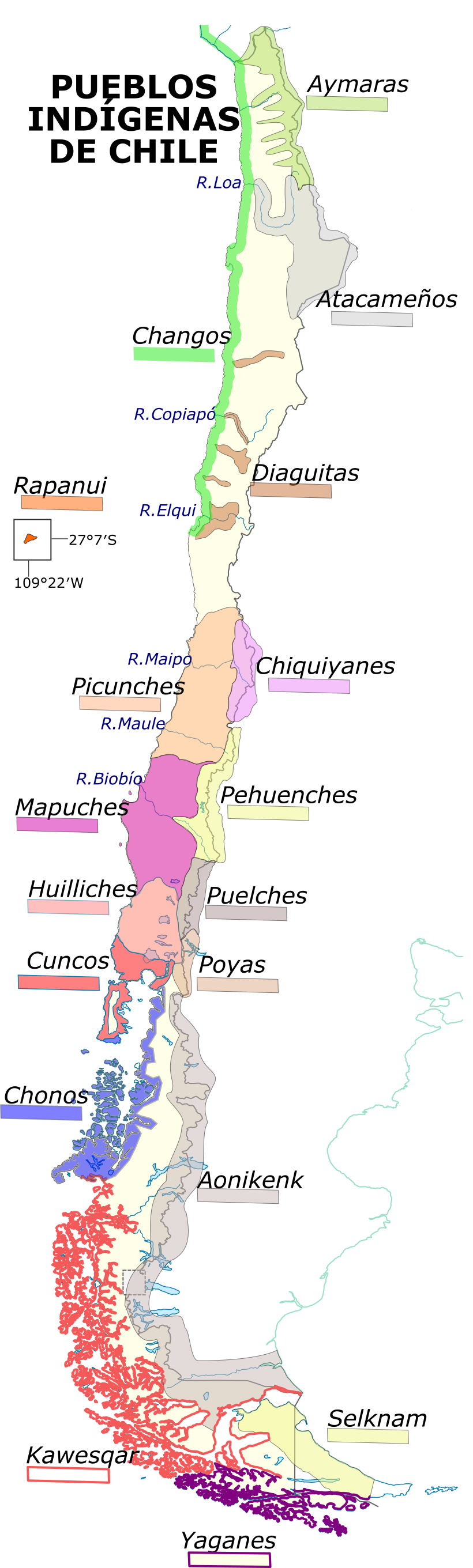
The challenges to the livelihoods of these communities are profound and mirror those faced by other indigenous groups across the continent. They range from the loss of habitat and exploitation of ancestral lands by outside entities to the gradual migration of young people to cities, as well as rampant poverty and its associated social ills, including crime and drug abuse. Resignation and acceptance are often fused with political activism and, in some cases, outright violence. Certain Mapuche communities in the southern Araucanía region have been in intermittent conflict with the state since the 16th century. The most recent resurgence was ignited after the fall of Pinochet. Representatives of the rebellion accuse the state and private companies of exploiting their ancestral lands for logging purposes. The attacks have targeted churches, forestry machinery, and state representatives. In response, the Chilean government has increased police presence in the region and detained or imprisoned leading figures of the movement. There is no end in sight to the conflict, and with the recent electoral victory of a right-wing candidate, José Antonio Kast—who has not rejected the idea of following Pinochet’s path in harshly suppressing the rights of indigenous people—the situation may become even more tense.
As we were heading to catch our return flight from Calama, I couldn’t help feeling uneasy at how much the ghosts of history continue to shape local identities and interactions. Since the Spanish conquista, there has been a persistent struggle over access to the resources of the peoples who have inhabited the continent for centuries. Gold and silver have now been replaced by lithium and wood, but the structure of the conflict has not fundamentally changed. However, whereas the benefits in the past mostly accrued to a handful of greedy conquistadors and a section of European aristocracy, today they are shared by a broader segment of the Chilean population, whose economic prosperity depends directly on the extraction and processing of abundant natural resources. Thus, the line separating ethical from unethical—which seems so trivial to draw when judging the actions of European ancestors—becomes unnervingly blurred when applied to the current predicament.
Sur
If Patagonia were an independent country, it would be one of the least populated in the world. Covering an area of 1 million square kilometers, it is inhabited by only two people per square kilometer. The region is split in two by a continuous slice of the Andes. The western side of the mountains is lined with rugged coastal fjords, while the eastern side stretches into vast flatlands that only end in the cold waters of the southern Atlantic. The difficulty of communication across this diverse landscape has been one of the reasons for its sparse and late settlement and colonization. The other is the weather. The freezing and unpredictable conditions near the tip of the Andes have long been a source of fear and tragic accidents for travelers, from sea navigators in the past to hiking enthusiasts today.
Patagonia was one of the last pieces of the continent to be inhabited by indigenenous people. After the arrival of Spanish, they didn’t rush to settle in this harsh climate either. Only starting in the 19th century, the newly founded independent states embarked on a concerted effort of colonising their southernmost territories. To find new inhabitans of these remote lands, they reached out to the old continent. The consequence of this odd movement of people are now unique pockets of European descendants whose villages and towns dot the map of Patagonia. Thus we may comes across Gaiman, a center of Welsh immigrants near the Atlantic coast, or tiny Swiss village called Colonia Suiza on the Argentinian side of Andes.
The area near Lake Llanquihue in the Los Lagos region on the Chilean side of Patagonia became the destination for several thousand immigrants from states that today form part of Germany. The first settlers arrived in 1852, as a result of the so-called Law of Colonization, enacted by the Chilean government in 1845 to encourage settlement in their southernmost (and also northernmost) regions. For the relatively young Chilean state, this was seen as a way to increase agricultural and industrial capacity. The law guaranteed families free land grants, full agricultural equipment, immediate attainment of citizenship, and coverage of all transport costs (source). With this level of generosity, it did not take long to find families willing to embark on a journey to start new lives on the other side of the planet.
The area around the lake experienced rapid population growth, with the gradual establishment of the towns of Llanquihue, Puerto Montt, Puerto Varas, and Frutillar in the 1850s. By 1871, the population of the newly founded province had grown to around 17,000 inhabitants (source). The new citizens fulfilled the role envisioned by the state, transforming the previously untouched volcanic landscape into farmland and pasture. The newly founded towns became commercial centers and important ports. A railway running from Atacama through Santiago reached its final stop in Puerto Montt in 1912. The settlement rush gradually slowed by the end of the 19th century, and by the 1930s it had fully halted with the nullification of the Law of Colonization (source). By that time, however, the Los Lagos region already had a population of nearly 100,000, boasted a strong agricultural and growing commercial and industrial base, and was fully integrated into the rest of the Chilean economy (source).
There is a plethora of reminders throughout the region of this latent German connection. Puerto Varas is home to a local German society (Club Alemán) and a Lutheran church (Templo Luterano). In Frutillar, you can find a German colonial museum, and Puerto Montt, the regional capital, greets visitors with a statue celebrating German colonization. Local restaurants may also offer German classics like schnitzel and apfelstrudel, which you can wash down with a local Kunstmann lager. However, aside from these exotic remnants of the past, the identities of the people seem to have largely relinquished their European roots. “Not a lot of people would identify as German these days. Maybe in the countryside the feeling is more prevalent, but overall it’s considered rather a curiosity to identify with your German ancestry,” a local museum owner and artist in Puerto Varas replied when I asked about the persistence of the old colonist identity. “It was a long time ago. I would say people feel Chilean first and foremost.”
The post-independence colonization wave was not the last migratory pressure that Chile would experience. At the end of the 19th century and the beginning of the 20th, Tierra del Fuego, at the southernmost tip of Patagonia, became the center of a gold rush that attracted a myriad of different nationalities, including a large community of Croatians, whose descendants still live today in Punta Arenas. Since the 19th century, a significant number of Italians and Palestinians also moved to the country—the former mostly for economic reasons, and the latter due to political and religious persecution in their homeland (these were Christian Palestinians). The second half of the 1930s saw a wave of Spanish refugees fleeing their war-ravaged country. The initial reception of these communities was mixed, ranging from neutral to rather cold, but today their full integration into Chilean society is undeniable. As a case in point, the last three nationalities have their own football teams—Audax Italiano, Unión Española, and Unión Palestino—which are recognized nationwide and regularly compete against each other in sold-out stadiums in the capital (source).
The most recent migrants coming to Chile still face a long road to full acceptance by the local population. These migrants are primarily economically motivated and come from other Latin American and Caribbean countries, especially Venezuela, Peru, Haiti, Colombia, Bolivia, and Argentina, with Venezuelans forming the largest group among foreign residents in Chile. The relatively small cultural and language barriers with many of these countries have aided overall social and labor integration, and it is now commonplace to see migrants working in a wide range of professions — from hairdressers and hotel assistants to cleaners — in cities across the country.
However, this relative ease of integration does not fully eliminate tensions associated with this most recent wave of immigration. Public sentiment has grown more strained since around 2017, when irregular crossings at the northern border — particularly through places like Colchane and into regions such as Iquique — began to spike, leading to highly publicized humanitarian situations and clashes between migrants and locals. The inflow of migrants, especially those entering without documentation, has continued in recent years, driven largely by ongoing political and economic crises in countries like Venezuela and Haiti. As of the latest estimates, Chile has nearly two million foreigners living in the country — close to 10 % of the population — and around 337,000 are in an irregular situation.
The news about these crossings and their implications for local residents not only became the top story in the country, but also marked a turning point in shifting the political discourse more toward issues of migration and crime. Chileans are becoming increasingly concerned about the rise in violent crime, and their concern is relatively well justified. Even though crime rates are still low compared to most of their neighbors, the homicide rate has almost doubled over the past 10 years, and there has been a tangible increase in violent robberies (source and source).
The Venezuelan crime syndicate El Tren de Aragua, which has recently become a major target of U.S. military interventions in the Caribbean, is one of the organized crime groups that has already established a presence in 14 out of 16 regions of the country (source). The gang’s extensive operations first came to light in November 2023, when Chilean businessman Rudy Basualdo was kidnapped and later freed after a ransom payment of around 4 million dollars, and again in 2024, when Venezuelan political activist Ronald Ojeda, exiled in Chile, was brutally murdered by associates of the gang (source). Unsurprisingly, due to their precarious socioeconomic standing, undocumented migrants are both more vulnerable to becoming victims of these larger drug and human-trafficking networks and, in some cases, more likely to turn to robbery or other crimes as a means of survival.
Thus, the combination of illegal migration and crime became a major political topic in the most recent presidential election. Even Kast’s opponent, Jeanette Jara, affiliated with the Communist Party of Chile, emphasized the need for stricter border controls and rejected proposals to allow undocumented migrants a path to Chilean citizenship. Kast himself, unsurprisingly, did not mince words, proposing a range of measures from building a wall and fully militarizing the northern provinces to deporting all undocumented migrants.
It seems Kast’s message resonated more with voters in the second round of the presidential elections. He won with the largest majority that democratic Chile has ever seen. Political analysts, however, stress that it was not his extreme views alone that tipped the scales. He had been working to soften his public image after previous political losses and had been feverishly building coalitions with other candidates to persuade more liberal and centrist voters. Additionally, his opponent’s chances were slightly hindered by Jara’s image as a continuation of the status quo (she had served as a minister in the previous government) and by the lingering stigma of the Communist brand in certain demographic groups (source). Nonetheless, the undercurrent of extreme views on both sides made the election more divisive than ever. On one side were citizens who could not believe that a supporter of a dictatorship, who had explicitly proclaimed anti-LGBT and anti-feminist sentiments, was about to become their president. On the other side were people who could not believe their compatriots had voted for a Communist who had, at one point, expressed views sympathetic to the Cuban regime.
Chile, following the examples of Argentina, Brazil, and the United States, is thus the latest country to have experienced a profoundly bitter and polarizing election. One view is that this marks a new era of global politics, with destabilizing repercussions that are yet to be seen. Viewed through the prism of Chile’s turbulent political and social history — with its numerous migration waves, political coups d’état, and endurance of a dictatorship — the situation may offer another perspective: the last election might be seen more as a new chapter rather than a complete shake-up.
‘Eso nos hace muy bien como país’
Complex modern democratic societies are almost inevitably based on conflicts of interest. It is impossible to allow millions of people to interact without their socioeconomic, ethnic, or religious backgrounds diverging. The more critical aspect for the coherence of modern societies, therefore, is not the absence of visible or latent social tensions, but the presence of mechanisms through which citizen unity can be reestablished. These mechanisms might include shared narratives about history, common traditions and celebrations, or political institutions through which differing views are expressed and heard in the arena of social life.
Chile is no different in this regard. The richness of its mineral reserves once pitted the interests of indigenous populations against Spanish conquerors, and it does so again today—perhaps in a less ostentatious way—against Chilean citizens. The socioeconomic growth of the past half-century has allowed a segment of the population to achieve a European-level lifestyle, while the rest are still striving to attain that status. The Pinochet dictatorship divided the nation into two camps: on one side, those who suffered personal tragedies as a result of the repression or whose political views were in complete opposition to the regime; on the other side, those who still view the dictatorship as the catalyst for a golden era of Chilean economic and social revival.
A sense that something more universal lay beneath all those disparate structures began to build as our travels progressed. From the feeling of pride in the lifetime of honest work by Doña Agosta and her family at their tiny restaurant in the downtown Mercado Central, to strangers willing to spend their evening helping us replace a flat tire in a forgotten Patagonian village, to the warmth and kindness we experienced interacting with people from all walks of life.
These tiny acts of sharing and caring came together as we picked up our luggage at Santiago airport after our flight from Calama. As we retrieved our suitcases from the conveyor belt, we noticed small paper tags tied to the handles: “Avión Solidario. Está en Teletón todos los días. 28 y 29 noviembre 2025.” (The solidarity plane. Teletón, on television on the 28th and 29th of November.) Curious, I asked the taxi driver taking us from the airport to our hotel in downtown Santiago about the tags. It turned out that they were part of a marketing campaign for Teletón, the country’s biggest charity event, happening that week. During those two days, all major national TV networks and radio stations join forces to create a 27-hour non-stop live program, inviting people to donate money to help children and young people with disabilities. The show first aired in Chile in 1978 and, due to its popularity, has remained a constant national event and has even spread throughout other Latin American countries.
As part of this year’s edition in Chile, over 50 million dollars were collected from more than 2 million people. That means nearly 15% of the population channeled some of their resources to help someone in need in just two days. I commented to our driver on how timely it was that such a generous charity event with a nation-wide reception was taking place against the backdrop of a massively polarizing presidential election. He replied with determination: “It’s very beautiful. It’s something that unites us, something to be proud of.” I couldn’t agree more. “You are right, it’s very beautiful,” I replied, as my gaze was gradually getting lost in the flickering lights of a warm and cozy Saturday evening in Santiago.
Articles and Books
A book by Bruce Chadwick: In Patagonia (in English) documents the experience of an English journalist travelling through Patagonia in the 1970s. It vividly conveys the region’s vicious weather conditions, its haphazard ethnic distribution, and its remoteness, with all the benefits and hardships that this entails.
Gabriel Garcia Marquez’s Clandestine in Chile: The Adventures of Miguel Littín (in English) is a thrilling account of Chilean director Miguel Littín, who decided to return to Chile undercover to film the situation on the ground during the Pinochet era. Interestingly, Littín’s father belonged to the above-mentioned generation of Palestinian immigrants.
Francis Goicovich’s Soldados, indios y franciscanos en la primera frontera continental del nuevo mundo (1529-1605) (in Spanish) documents the first interactions between Indigenous communities, Spanish conquistadors, and Spanish clerics. Although centred on areas of modern-day Mexico, the patterns analysed are useful for understanding broader characteristics of European colonisation across the continent.
A selection of articles (in Spanish) on the history of Chile collected by the National Library of Chile: https://www.memoriachilena.gob.cl/602/w3-propertyvalue-137763.html
An El Pais article (in Spanish) on the sprawling influence of the El Tren de Aragua gang—a particularly poignant topic given recent American intervention in Venezuela: https://elpais.com/chile/2025-08-24/el-tren-de-aragua-el-gran-problema-de-chile.html
An El Pais article (in Spanish) on the uncertainty felt by migrants living in Chile following Kast’s victory: https://elpais.com/chile/2025-12-22/los-migrantes-irregulares-en-chile-tras-la-eleccion-de-kast-es-dificil-estar-tranquilos-sabiendo-que-podemos-ser-expulsados.html